Energy System
This is a supplementary introduction to the Energy System in the Moon Sprout mod, explaining each detail of the Energy System in further depth.
In Moon Sprout I greatly expanded the content of the Photosynthesis skill. The blooming path also contains the related skills Tenacious Plant, Symbiotic Bond, Moonlight Creation and Lune Tree Therapy. They improve the efficiency of Photosynthesis along different dimensions, and together they make up Wormwood's Energy System.
Want photosynthesis to run at maximum efficiency? Start here#
Step 1: Sunbathe during the day or near a Dwarf Star!
Step 2: Take your hat off, keep the air flowing around your head, and absorb light energy to the fullest!
Step 3: Want to push it even higher? Try watering yourself — the wetter the better — but be careful not to freeze!
Energy system flow chart#
What follows is a complete introduction to how the Energy System works, explained item by item along the flow above.
Energy input#
Photosynthesis begins with energy input. The "energy" in question means solar energy, or light energy. Its input comes from many different sources, which can be divided into strong light sources and weak light sources.
Sunlight energy input#
- Strong light sources: these include sunlight during the day, and the Dwarf Star.
- Weak light sources: these include sunlight at dusk, Cave light, and Wickerbottom's Lux Aeterna. As for other light sources such as Auroras, Lanterns and Campfires — they have no effect on Photosynthesis in the vanilla skill, and I have kept that mechanic, so they are not included among the energy input sources.
- No energy storage: the Energy System has nothing like a battery, so it does not store light energy. It runs while there is light and shuts down when there is none.
Nighttime energy input#
The Energy System has one additional source of external input, namely the Moon Moth healing from Lune Tree Therapy and the moonlight blooming from Moonlight Creation.
- Moon Moth healing: while blooming at night, one to three Moon Moths may appear around Wormwood. They can absorb energy from the moonlight and then heal Wormwood.
- Moonlight blooming: likewise, while blooming at night, Wormwood absorbs energy from the moonlight, promotes its own blooming, and continuously restores Bloom Points.
- Moon phase factor: the fuller the moon, the higher the chance that Moon Moths appear, and the more efficient the moths and the moonlight are at healing and blooming — during a Full Moon they provide a recovery ability far beyond what ordinary daylight can reach.
- Post-Lunar factor: once the Post-Lunar stage is reached, the amount of recovery provided by the Moon Moths and the moonlight is doubled.
Factors that affect the size of the energy input#
- Light intensity factor: a strong light source provides 100% of the energy input, while a weak light source provides only 50%.
- Head factor: with the head uncovered and the blooming flower exposed, the efficiency of the energy input is doubled.
- Humidity factor: Wormwood's own wetness can further raise the efficiency of Photosynthesis. This bonus only takes effect once the Tenacious Plant skill is active.
- Curved water absorption capacity: the higher the wetness, the faster the wetness itself declines, and the higher the efficiency of Photosynthesis. I will not list the mathematical expression by which wetness affects the energy input here; anyone interested can look through my code.
Allocating energy to the primary supply tasks#
The input energy is first used to restore Health, to slow the loss of Bloom Points, and even to promote blooming.
Supply priority 1 — The Health restoration task#
However much or however little energy is being input, bringing Wormwood back from an injured state is always the most important thing. The Energy System therefore puts all of its energy into Health restoration first, which also brings the other supply tasks back into normal operation as early as possible.
Supply priority 2 — The Bloom Point restoration task#
Once Health is full, the Energy System puts its energy into restoring Bloom Points. If the Symbiotic Bond skill point is active, then once Bloom Points are above 1800, the Energy System sets aside a portion of its energy for the secondary supply tasks while keeping at least half of it for Bloom Point restoration, until Bloom Points are completely full.
Allocating energy to the secondary supply tasks#
Allocation principle for the secondary supply tasks#
Starting the other secondary supply tasks requires the Symbiotic Bond skill point to be active. When Wormwood's Health is full and Bloom Points have been restored above 1800, the Energy System can start the other secondary supply tasks.
The priorities of these tasks are as follows#
Restoring the freshness of mushroom items and Ivy equipment.
Extending pet survival time.
Synthesizing Lune Tree Blossoms.
Synthesizing butter.
The energy allocated to the secondary supply tasks changes dynamically: the Energy System allocates energy tier by tier, keeps a real-time count of the consumption of every secondary supply task, and sums it all into the Lune Tree Blossoms, so you can learn how the Energy System is currently running by examining a Lune Tree Blossom. When energy is plentiful, all of these secondary tasks can normally be supplied.
Secondary supply task 1 — Restoring the freshness of special items#
The Energy System can restore the freshness of mushroom items and Ivy equipment.
The mushroom items whose freshness can be restored include uncooked tri-color mushrooms, Mushy Cakes, Stuffed Night Caps and all kinds of Funcaps. Moon mushrooms rotting in my hands often drove me insane, so I added this supply task.
For certain historical reasons, on top of restoring the freshness of mushroom items and Ivy equipment, the Energy System can in fact also restore the freshness of the three Floral Swords from the Legion mod.
Secondary supply task 2 — Extending pet survival time#
The pet supply task is usually the most energy-hungry task of all. The Energy System's surplus energy can be used to supply each pet, letting it live longer. The Energy System will satisfy the Bulbous Lightbug's energy demand first, in order to guarantee its light output, and only then supply the other pets.
Secondary supply task 3 — Lune Tree Blossom synthesis#
Synthesizing Lune Tree Blossoms provides a regular supply of casting items, so that players do not have to burn Health to craft a Lune Tree Blossom just to cast a skill and interrupt the operation of the Energy System. To a certain extent this is also a reward for keeping Bloom Points high for a long time.
Synthesizing one Lune Tree Blossom requires a total of 2500 energy. This task has an upper limit on its synthesis rate: at most 10 points of energy per second are allocated to synthesizing Lune Tree Blossoms. It also has an upper limit on quantity: when 40 Lune Tree Blossoms are present in the inventory, the Energy System stops synthesizing, so as not to flood you with them. Usually one Lune Tree Blossom can be obtained per day.
Lowest secondary supply task — Butter synthesis#
The butter synthesis task is the lowest priority of all the supply tasks, and only runs once every other task has been satisfied. Moreover, before Bloom Points reach their cap, the Energy System allocates only a small part of its final leftover energy to this task and keeps the rest on Bloom Point restoration, guaranteeing as high a Bloom Point recovery rate as possible.
Once Bloom Points reach their cap, the Energy System puts all of its remaining energy into synthesizing butter. Synthesizing one butter requires 50000 energy, and a butter eaten directly restores 25 hunger and 160 Bloom Points — which makes that synthesis reward pretty acceptable, doesn't it?
Recovery rates of the Energy System's supply tasks#
Conventional energy input rate#
Although the energy input rate is affected by many factors, players chasing the highest energy input rate will normally remove their headgear and stay in daylight or near a Dwarf Star. The energy input rate at that point is the conventional energy input rate, i.e. 100 points of energy per second (100 EP/s). This is the rate at which the Energy System spends most of its time, and it will be used repeatedly below, so it is called out here in particular.
Health restoration rate#
Of the energy allocated to the healing task, every 1 point of energy can be converted into 0.2 Health. Therefore, at the conventional energy input rate, 0.2 Health is restored per second. At dusk the sunlight weakens, and 0.1 Health is restored per second.
Bloom Point restoration rate#
Of the energy allocated to the Bloom Point restoration task, every 100 points of energy can be converted into 1 Bloom Point. You may however have noticed that restoring 1 Bloom Point per second is basically very hard to achieve — this is because Wormwood's Bloom Points are subject to natural seasonal withering, and the energy allocated to the Bloom Point restoration task must first overcome that natural seasonal withering before Bloom Points can actually grow.
(For how many Bloom Points a withered Wormwood gains when it re-blooms, see Re-blooming.)
Natural seasonal withering#
Wormwood blooms naturally in Spring, and at full bloom his Bloom Points stay constant, so there is no natural seasonal withering in Spring. In every season other than Spring, the natural withering of blooming exists.
In Summer and Autumn, Wormwood loses Bloom Points at a rate of 1 Bloom Point per second, written as -1.0 BP/s.
In Winter this withering is more severe, and the rate intensifies to -2.0 BP/s.
The contribution of Tenacious Plant to Bloom Point change#
The Tenacious Plant skill has one important ability: it halves the rate of natural seasonal withering, which brings the Bloom Point decay down to -0.5 BP/s in Summer and Autumn and -1.0 BP/s in Winter.
Outside of Spring, it is very hard to have any chance of achieving positive Bloom Point growth with the Photosynthesis skill point alone; the purpose of this skill is to reduce the energy Wormwood has to invest in maintaining Bloom Points, making positive Bloom Point growth possible during the daytime.
Energy demand of the various items in the secondary supply tasks#
The energy demand of a given item depends on its spoilage rate: the faster an item spoils, the higher its energy demand (0.05 ~ 1 point of energy per second). The rate at which the freshness of mushroom items and Ivy equipment is restored is equal to twice their spoilage rate.
Pet energy demand#
| Consumption | Energy per second | Pets |
|---|---|---|
| Low consumption | 0.4 | Carrat, Bulbous Lightbug, Piko |
| Medium consumption | 0.8 | Saladmander, Elder Mandrake, Grass Gator |
| High consumption | 1.2 | Venus Flytrap |
Note that the energy demands above are only the values for pausing a pet's survival countdown; while a pet's state is being restored back up to four days, additional energy is consumed on top of them:
- Paused survival time (≥ 4 days): +100% energy consumption.
- Restoring survival time (< 4 days): +200% energy consumption.
In addition, the Energy System's supply efficiency for a sleeping pet is increased by an extra 50%, and a pet that is receiving supply generates a glowing shadow beneath its feet. That shadow can be used to tell who is currently being supplied and who is not getting any energy.
How to learn the Energy System's current status#
Clicking the Bloom Point meter opens the Energy System Report panel, where you can examine the operation of the whole system in detail. Those of you who are interested can use it to study the numbers!
Under the brief report, examining a Lune Tree Blossom shows, in order, the Bloom Points and their rate of change — the Energy System Report — and a short line of dialogue from Wormwood. If you have turned on the detailed report in the mod's configuration options, it will also show the seasonal withering, the Lune Tree Blossom production progress and the butter production progress.
What each piece of information in the Energy System Report means#
- No Energy: indicates that no light source is shining on Wormwood, and the Energy System has no energy with which to operate.
- Bud Growing: indicates that the Energy System is using the input energy to accelerate blooming.
- Withering: indicates that Wormwood has lost the blooming state and the Energy System has stopped operating.
- Healing: indicates that the Energy System is restoring Health, and will use up all of the input energy.
- Slowing Decay: indicates that the Energy System is restoring Bloom Points, but there is too little energy to offset the natural seasonal withering, so it can only slow that withering down.
- Maintaining Bloom: indicates that the Energy System is restoring Bloom Points, but there is not much energy — just enough to exactly offset the natural seasonal withering.
- Restoring Bloom Point: indicates that the Energy System is restoring Bloom Points, and there is plenty of energy, so positive Bloom Point growth can be achieved.
- Light Load: indicates that the Energy System has a large amount of idle energy available. Light Load normally only appears when Bloom Points are full; at that point Wormwood does not need Health or Bloom Point restoration, and there are not too many secondary supply tasks to supply either. If this idle energy has no other use, it goes into synthesizing butter.
- Medium Load: indicates that the Energy System has a portion of idle energy available. Medium Load normally only appears when Bloom Points are full; at that point the Energy System may have allocated some energy to the other secondary supply tasks, but there is still enough left over to keep allocating. If this idle energy has no other use, it goes into synthesizing butter.
- Heavy Load: indicates that the Energy System has only a small amount of idle energy available. Heavy Load normally only appears when Bloom Points are between 1800 and 3600; at that point the Energy System is mainly allocating energy to the Bloom Point restoration task, while a portion of the secondary supply tasks also need to run. In this situation only a very small amount of idle energy goes into synthesizing butter.
- Overloaded: indicates that the Energy System's supply currently falls short of demand. This normally only appears when Bloom Points are between 1800 and 3600, or when the light conditions are poor while the supply tasks are heavy — for example, carrying two hundred mushrooms around to restore their freshness while a whole convoy of pets is crying to be fed. In this situation there is no idle energy at all, and there are supply tasks whose energy demand cannot be met.
- Idle: indicates that the Energy System has not started and is in an abnormal state. Theoretically this should never happen; if you do run into it, please tell me.
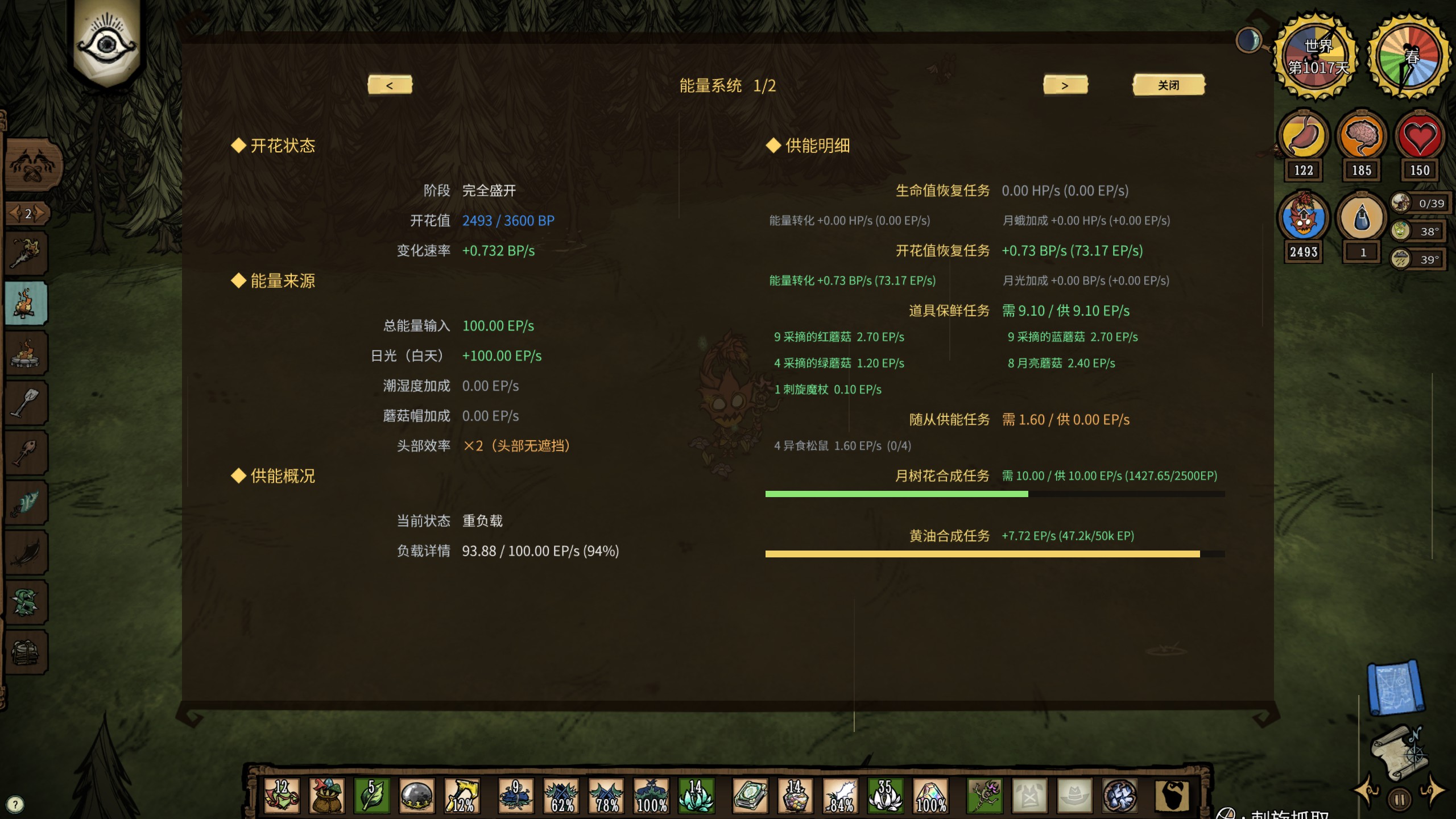
Energy System Report#
Click the bloom-point dial at the top right of the game to open the Energy System Report page. It is split into four parts — bloom state, energy sources, supply overview, and the details of every supply task — so this is the quickest page to flip through if you want to see what the system is busy with right now.
Summary#
The Energy System is a further extension of Photosynthesis. It can strengthen Wormwood's own recovery ability and also benefits the other skill lines — it is an important component of the blooming path.
Rant#
I have always been quite dissatisfied with Photosynthesis in the vanilla skill tree. Its standing is very awkward, and the time during which it works is short. While slacking off at home you can still feel a bit of its presence, but if you want to rely on it to support Bulbous Lightbugs, it turns out not to be enough.
In the vanilla skill tree, 3 Bulbous Lightbugs are already enough to provide the light needed for normal activity; 6 lightbugs do no more than widen the lit area a little.
Yet whether you summon 3 lightbugs or 6, they all croak after 3 days. Relying only on the daily healing that vanilla Photosynthesis provides, it is not really enough to continuously maintain 6 summoned lightbugs — unless you stay near a Dwarf Star the whole time. But then again: if you are already staying near a Dwarf Star, why summon lightbugs at all?
In Summer and Autumn the daytime period is still fairly long, and Photosynthesis provides a lot of healing then; but you will find that the night is also short, so the lightbugs' utilization rate is not high, and a Lantern saves resources instead. In Spring and Winter you find that the night has grown longer, but by then the day has grown shorter, so Photosynthesis stops after healing very little and is simply not enough to maintain 6 lightbugs. Spring, the season that favors the plant man, is not the season that favors Photosynthesis. Funny.
Wormwood himself is already tight on Health, so what reason does the player have to summon 6 lightbugs? Even staying at home, sleeping in a tent every day to heal really is annoying. Not to mention that these lightbugs are very fragile — a passing Catcoon can slap one down with a single paw.
I could not accept being unable to continuously maintain Bulbous Lightbugs, and so I expanded this supply task. That way I have a reason to summon 6 Bulbous Lightbugs. Lovely.
Recent updates#
Text revisions.